Immediate Safety
We secure the site and remove the immediate threat to your family and homestead.
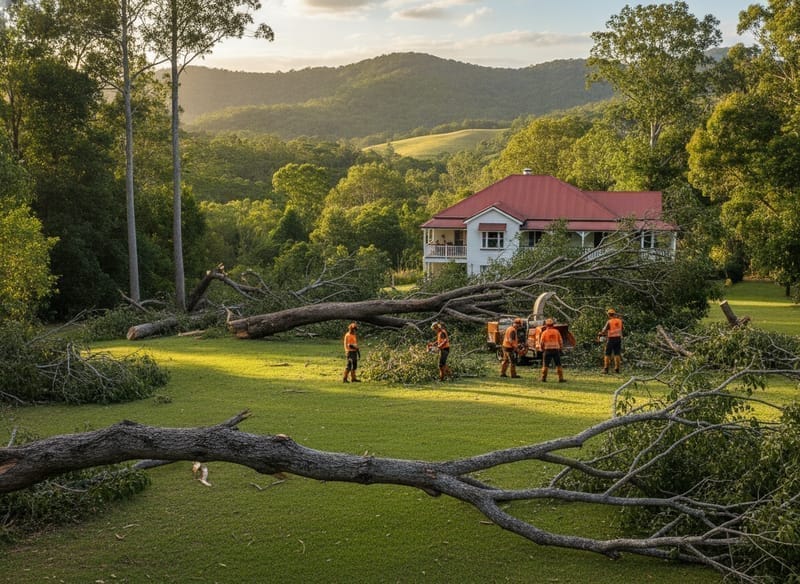
We make safe and remove fallen, hazardous, and storm-damaged trees threatening your acreage home or access tracks.
Available day and night across Clear Mountain and surrounding suburbs.
Our Emergency Tree Removal Clear Mountain service is designed to mitigate immediate risks following severe weather, lightning strikes, or sudden root failure.
Severe storm cells frequently roll off the D'Aguilar Range, hammering Clear Mountain's tall open eucalypt forests. When the winds hit, sudden limb shear and uprooting from waterlogged soils are common.
We secure the site and remove the immediate threat to your family and homestead.
We quickly clear acreage driveways so you aren't trapped on your property.
Removing hung-up limbs before they crash through your roof saves thousands in secondary damage.
Phone our emergency line. We will assess the urgency and dispatch a crew.
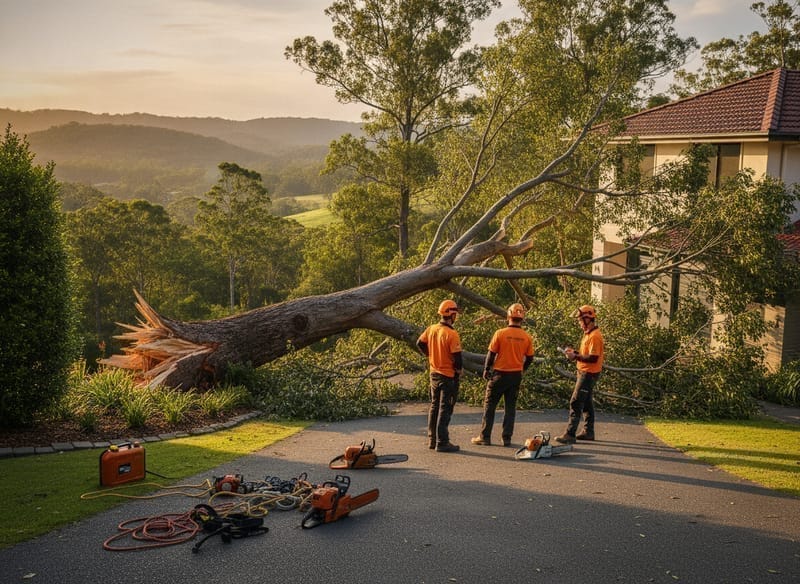
Upon arrival, we secure the perimeter, assess the tension in the fallen timber, and plan the safest cuts.
We remove the sections threatening structures or blocking access using chainsaws and winches.
We chip the branches and leave the site safe. Large logs can be processed the following day if needed.
When severe storms hit the Hills District, compromised timber can turn into a critical hazard in seconds, making Emergency Tree Removal Clear Mountain an absolute necessity for local homeowners and acreage properties. Whether a massive flooded gum has dropped a structural limb onto your roof, or a legacy hoop pine is heavily leaning after saturated wet-season soils, our team of qualified arborists is ready to respond. We understand the unique terrain of acreage blocks, steep hinterland properties, and winding roads in this region. When you call us, you get our actual climbing arborists and our heavy-duty trucks. We prioritise make-safe operations to protect your home, family, livestock, and assets. From sudden root-plate failures to catastrophic storm damage, we have the specialized machinery and the AQF Level 3 climbing expertise to handle the most dangerous, complex emergency extractions safely and swiftly. We are your local on-the-ground experts for tree disasters.
After a major storm cell sweeps through the City of Moreton Bay, panic often leads property owners to make dangerous decisions. Attempting to clear a fallen or hung-up tree yourself using a standard hardware-store chainsaw is a recipe for severe injury or property damage. Storm-damaged trees are under immense, unpredictable tension and compression forces. One wrong cut can cause a massive trunk to snap back, roll unpredictably, or completely crush whatever is beneath it. Equally risky is hiring under-qualified tree loppers who lack proper insurance and AQF qualifications. Unskilled operators often rush the job, failing to execute controlled rigging techniques, which frequently results in secondary damage to your property, fencing, or remaining protected vegetation. Our team provides a professional, highly calculated solution. We approach every emergency extraction with a strict adherence to safety standards and a deep understanding of structural tree mechanics. If a tree is partially uprooted but still standing, we secure the site, assess the root plate's structural integrity, and use advanced rope-access climbing or crane-assisted dismantling to bring it down in a controlled manner. We ensure that your emergency response is executed safely, completely eliminating the hazard without creating a new one.
Executing an emergency removal safely requires specialised gear and advanced rigging techniques, particularly on the sloping blocks and tight access roads common to the Hills District.
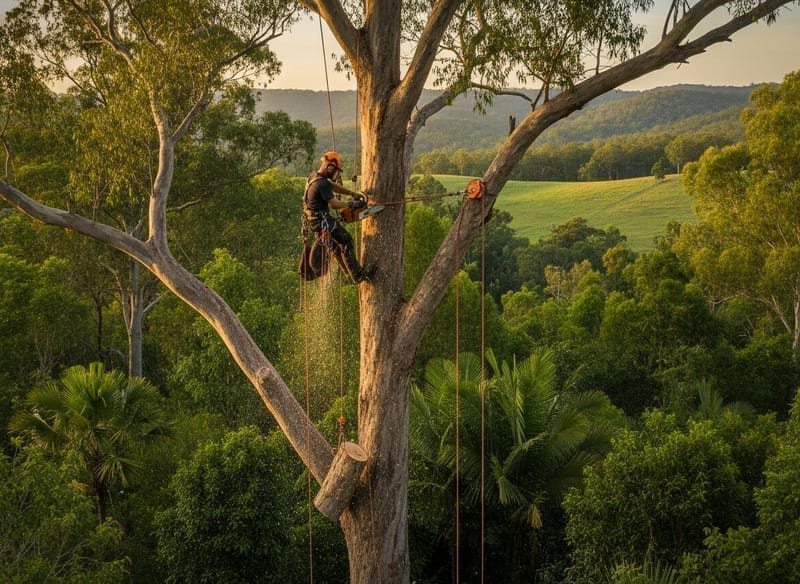
When ground conditions are too soft from heavy rain or the tree is located in a steep gully where an Elevating Work Platform (EWP) cannot reach, our AQF Level 3 arborists utilise double-rope climbing techniques and friction-brake rigging to dismantle hazardous timber piece by piece over sensitive drop zones.
For catastrophic failures where a massive hoop pine or flooded gum has fallen onto a house or structural roof, we coordinate crane-lift removals. We sling and cut multi-tonne sections, lifting them up and away to prevent any further structural damage to your home.
Once the dangerous timber is safely on the ground, our ground crews use commercial-grade chainsaws (like the Stihl MS500i) and large 12-inch wood chippers to rapidly process the canopy. We turn the hazardous debris into reusable mulch or haul it away in our tipper trucks.
In after-hours scenarios where full removal isn't possible due to visibility or ongoing extreme weather, our priority is a make-safe operation. We remove the immediate threat, secure hung-up branches, and can assist in making the area safe until full daylight extraction.
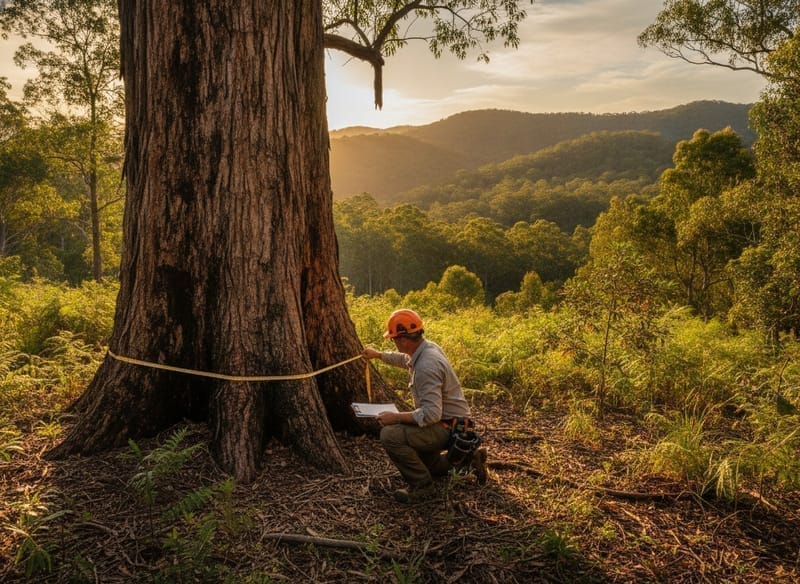
When a tree fails on your property, time is of the essence. Here is exactly how our local crew handles emergency extractions from start to finish. - Immediate Contact & Triage Assessment: When you call us, we assess the urgency of your situation over the phone. We ask about downed power lines, structural damage, and site accessibility to prioritise the most critical hazards in the Hills District. - On-Site Hazard Evaluation: Our crew arrives promptly. The lead arborist assesses the tension of the fallen timber, the stability of the root plate, and the safest extraction method. We take comprehensive pre-work photos for your insurance claim documentation. - Make-Safe and Controlled Dismantling: Using our EWPs, spider lifts, or advanced rope-access climbing, we isolate and remove the most dangerous limbs first. If a heavy Moreton Bay fig limb is hung up in the canopy, we carefully rig it out using heavy-duty pulleys and friction lowering devices to avoid dropping it on structures below. - Cleanup and Insurance Reporting: We process all debris through our 12-inch commercial wood chippers, leaving your driveway and yard clean and safe. Finally, we provide an itemised invoice and a written arborist assessment detailing the cause of failure, which you can hand straight to your insurance assessor.
Emergency tree work carries extreme physical risk, which is why strict compliance and proper certification are non-negotiable for our team. We hold full Public Liability insurance and comprehensive WorkCover for all our staff, giving you total peace of mind when our trucks roll onto your property.
We operate in strict alignment with AS4373 pruning standards where salvage of damaged limbs is possible, and follow AS4970 guidelines if heavy machinery needs to navigate around retained protected trees on acreage blocks. Furthermore, the City of Moreton Bay planning scheme often allows exemptions for dead, dying, or imminently dangerous trees. Our AQF Level 5 consulting arborists can provide the required written and photographic documentation for your records and insurance claims.
Providing Emergency Tree Removal Clear Mountain requires deep local knowledge and specific operational tactics. This area is heavily characterised by steep acreage blocks, narrow winding roads, and a dense subtropical canopy. During the summer storm season, saturated volcanic soils frequently lead to sudden root-plate failures in massive flooded gums and top-heavy hoop pines. We also routinely navigate the complexities of local Koala Habitat Areas and bushfire overlays. When working in BAL-rated properties, we are mindful of how emergency clearing impacts your Asset Protection Zone (APZ). Unlike flat suburban blocks, Clear Mountain often demands complex traffic management on tight hillside bends and specialized tracked spider lifts that can handle muddy, uneven terrain without destroying your paddocks or driveway. Because we service the Hills District daily, we already know the local terrain, the dominant species, and the fastest, safest routes to get our emergency units to your gate when disaster strikes.
Once the immediate emergency is resolved and the hazardous timber is safely removed, your property still requires ongoing attention. We strongly recommend leaving the stump grinding for a later date when the ground has completely dried out, avoiding unnecessary heavy machinery rutting to saturated turf. You should also carefully monitor your surrounding trees in the weeks following a major storm. High winds that caused one tree to fail can often cause hidden micro-fractures in the branches of neighboring blackbutts or brush boxes. Keep a close eye out for hanging deadwood, sudden leans, or fresh cracks in the soil around the base of large trees. If you spot any of these warning signs, call us back for a comprehensive post-storm risk assessment.
Emergency callouts incur an after-hours fee, but our pricing remains fair and transparent, even in a crisis.
Call us directly for an estimate and dispatch.
Help available throughout the local acreage areas.
Call our emergency arborists in Clear Mountain right now.
Call 0468 169 959